Maurizio Simonetti, a life of running
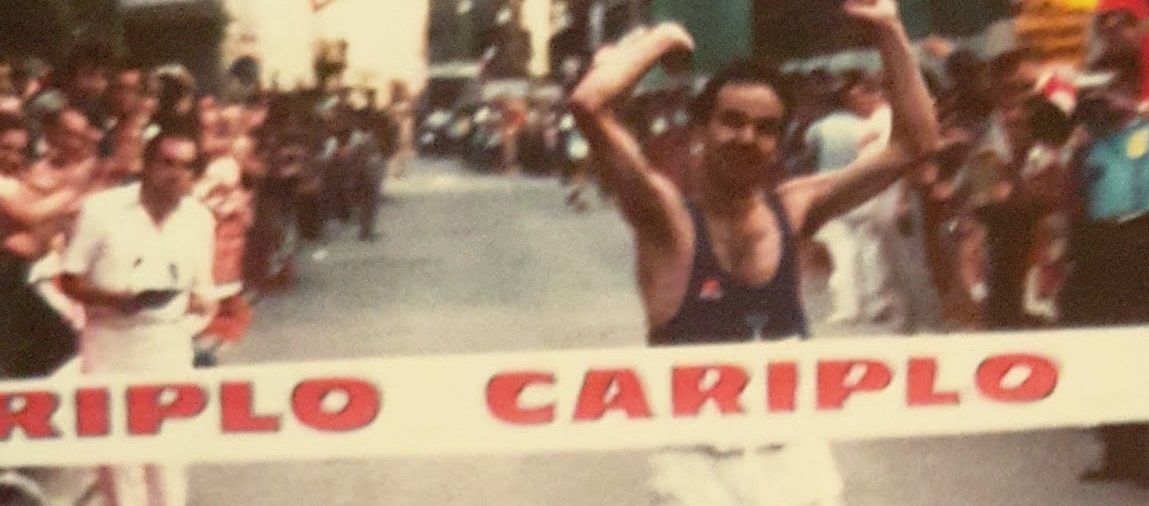
It is not often that you find a sensitive and attentive person who has competed at a high level and is still driven by an all-encompassing passion for running.
I am talking about Maurizio Simonetti, originally from Ogliano di Conegliano, today an organizer of sporting events and, in the past, an athlete for the State Forestry Corps (Forestale). His finest podium moment was in 1985, when he won an individual and team gold medal at the World Mountain Running Championship in Valtellina, and besides this victory, Maurizio was a key participant in important cross-country races, alongside champions like Bordin, Panetta, and Cova.
Given his experience, we ask Maurizio what the differences are between the athletes of that time and those of today. 'With great joy, I see that for some years there has been a consistent and growing number of people venturing into mountain running, trail runs, and vertical runs,' says Maurizio; 'there is also a very varied offering from the organizers. Today, athletes who run trails cultivate endurance much more than speed, whereas in the past, even those who ran off-road trained for speed on the track, and it was natural to also compete on the road and have competitive times on the track. In the past, whoever won important mountain races was capable of running 10,000 meters in around 30 minutes, while now almost no trail specialist can run at that pace. Furthermore, in the past it was inconceivable to face a mountain race and compete the following week; longer recovery times were needed for the effort, while now many top athletes run every Sunday. There is undoubtedly a lot of specialization.
Tell us something about your training as a professional. 'Preparation began in the autumn and the results were harvested in the following spring and summer; we ran on all terrains and slopes. Even though I was trained by Raimondo Balicco, a very prepared coach for the Italian National Team, I always had a particular sensitivity for creating my own training schedules and a strong sense of duty to follow them and not cut corners; I always liked putting in the hard work, otherwise I would never have chosen mountain running, where the ascent is tough, but, perhaps not everyone knows, the descent is even tougher.'
How was your transition from a sports career to a professional one? 'Competing for the State Forestry Corps, I alternated training periods with periods of intense instruction, as I was aware that I wouldn't run forever; within the Forestry Corps, I held various positions and carried out diverse activities involving responsibility and personnel management, which gave me great satisfaction; in fact, I retired with the rank of Vice-Commissioner. I learned a lot in the ranks of this military body, for example, the importance of work group cohesion, attention to security, the importance of organizing things well in advance, to be ready to manage unforeseen events, which sooner or later arise. By my nature, I am very curious, ready to learn new things, and to challenge myself, which is why I frequently held various types of roles, with different responsibilities.'
Roles of various types, for example? 'I had the satisfaction of traveling the world, for four years, in the role of director of the Pasta Zara Astana women's cycling team, which was the fourth best in the world at the time; it was a very intense period. I accompanied the team in training and competitions in Costa Rica, Honduras, San Salvador, Qatar, the United Arab Emirates, Japan, and China, but then I realized that this activity kept me too far from home and so I decided to stop it. I then managed all the logistics and security for the first four editions of the Treviso Marathon, with great commitment and satisfaction, given that we became the fifth marathon in Italy in terms of the number of finishing athletes. I also challenged myself as a talent scout, going to Ethiopia and Uganda with Gianni De Madonna’s team (an athlete manager) to find athletes to train in Italy and subsequently have them participate in important meetings in Europe. I had the satisfaction of teaching a very talented Ethiopian girl how to clear hurdles and then saw her participate in the Olympics. However, with this activity, we are not simply technical coaches, we have to improvise as psychologists, as we deeply touch upon the character and motivations of athletes who, coming from countries so different from ours, often have attitudes that are difficult to understand and accept.'
Maurizio, and now? 'For several years, I have been the president of the ASD Running Team of Conegliano; we develop promotional activities with about thirty young people and two excellent female coaches, Marinella and Valentina; we also have forty master athletes. I am a full-time organizer, in the sense that I manage competitive and non-competitive races throughout the year, between Friuli Venezia Giulia and Emilia Romagna. Some "Corse in rosa" (Pink Runs), in Bibione, Conegliano, Montebelluna, but also the Cansiglio Run, the Mezza di Rovigo (Rovigo Half Marathon) and, recently, I was proposed to manage the logistics of the first edition of the Mezza di Riccione (Riccione Half Marathon), which will be the European Firefighters Championship. Particularly in these races, I follow the road safety plan, to cause the minimum impact on traffic and the minimum disturbance to the citizens; I coordinate the volunteers, I organize the aid stations... behind every sporting event, from the simplest to the most complex, there is a mountain of work, which those behind the barriers cannot imagine.'
What is the most important thing in a sporting event? 'First and foremost, safety, for the athletes, volunteers, and the public. Frankly, I don't entirely agree with those who organize trails longer than 40 km, because beyond these distances, the athletes, volunteers, and even the organizers, who have many responsibilities, are put at risk. Races that start or finish at night, with artificial lighting, are, in my opinion, more "ventures" than sporting events. However, it's known that today it is often the sponsors who dictate the rules and impose modalities and deadlines. Besides safety, of course, the enjoyment and satisfaction of everyone are also important; not just the athletes, but also the volunteers. These are two fundamental sentiments that must be closely monitored. I am very proud of my group of loyal collaborators, whom I take with me to various events, without whom I could not be a respected, esteemed, and well-liked organizer.'
When did you get to know Keepsporting? 'Years ago, this platform was proposed to me to manage online registrations, and I immediately found it flexible, easy to use, advantageous from several points of view, and suitable for my needs; I also recommended it to several organizer colleagues.'
A closing greeting? Besides a greeting to all sports enthusiasts, I would like to thank everyone who places their trust in me—organizers, sponsors, collaborators, athletes... because, for me, this feeling matters a great deal and is perhaps the greatest stimulus to doing things well and giving my best, just as I did when I ran in the mountains.